
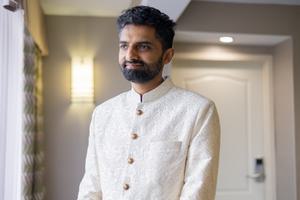
Center for Healthy Minds Spotlight: 3 Questions with Zishan Jiwani, Graduate Researcher
January 12, 2024
Have you ever pondered why some individuals choose to engage with meditation whereas others don't? That’s one of the root investigations of Zishan Jiwani’s research at the Center for Healthy Minds.
As a graduate student working on his doctorate with Core Faculty Member Dr. Simon Goldberg, Zishan’s studies and career have taken him to Kenya, Uganda, India, and now, Madison, WI.
In chatting with Zishan, it became apparent he has a resolute commitment to social justice and equity and hopes to bring that perspective to his work at CHM.
Explore more of his recent research in a paper published this year in NPJ Mental Health Research that examines equity in access and utilization of a freely available meditation app.
What does well-being mean to you?
Well-being is the capacity to understand the nature of mind and accept whatever comes up.
In your past research, what is something that you think people will find interesting or should know?
Like many psychological interventions, such as therapy, meditation has a demographic problem. Those who use it are more likely to be White, college-educated and well-off. Marginalized and minoritized populations, who may benefit from meditation, are not using it at the same level.
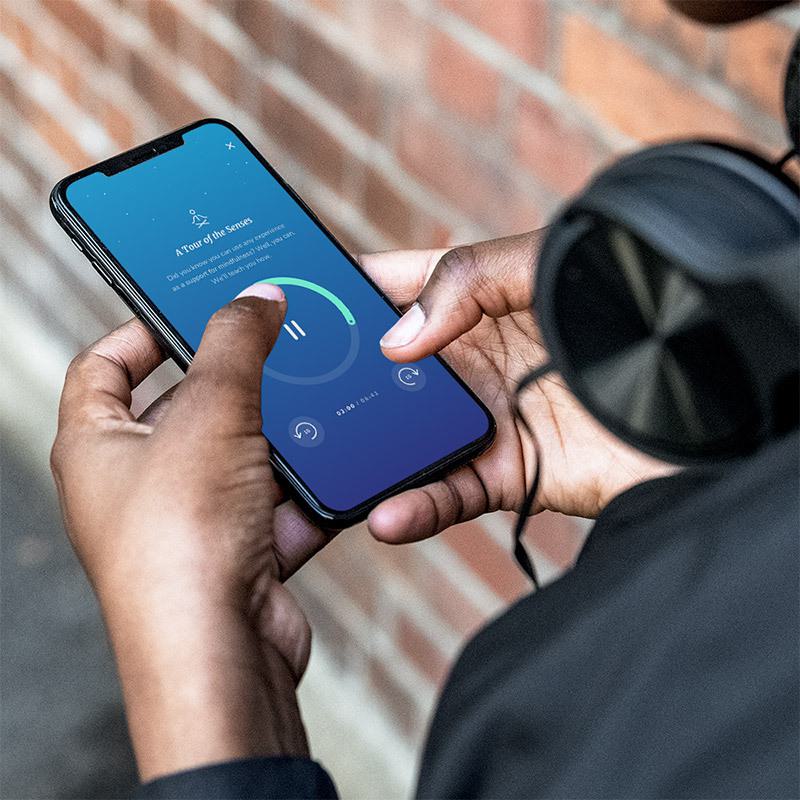
This is true even when it’s freely available and accessible, like the Healthy Minds Program app. So, what we need to collectively better understand is: why is this happening, and what can we do about it?
What upcoming research will you be working on?
Along with Dr. Goldberg, I have the privilege of working on a few different projects which we hope to submit for publication soon.
In one forthcoming study, we are comparing sitting meditation and active meditation practices. Traditionally, most of us think of meditation as something to do sitting down. However, as meditation teachers have taught for millennia, meditation can be done anytime, such as when taking a walk or washing dishes.
Our goal is to understand the demographic differences in sitting vs. active meditation, as well as to understand if there are differences in outcomes when folks engage in sitting, active or a combination of both. If you’d like to learn more about sitting and active meditation, you can check out the Healthy Minds Program app.
Related: Read the grant announcement about Zishan's upcoming work.
By Victoria Vlisides
Latest News

A beacon of Black brilliance
May 6, 2026
This InBusiness article talks about the vision of Dr. Rev. Alex Gee and other foundational supporters from the Black community who made the Center... Learn More

Art, Music, and Neuroscience: The MUSE Initiative Holds its Inaugural Event
May 5, 2026
The evening extended beyond dialogue into shared experience where participants were invited into moments of collective vocalization, simple vocal... Learn More >

Faith Leaders’ Environmental Visions Come to Life at Loka Initiative Convening
April 29, 2026
The PREP (Preparing Religious Environmental Plans) course culminated in a weeklong “Keeping the Faith” convening in March in Madison, WI. Learn More >